
If you smell something musty or see spots on a wall in your Fort Myers or Lee County home, an inexpensive mold test kit can look like an easy first step. Before you buy one, it helps to know what these kits actually measure, what EPA says about testing, and what a professional mold assessment adds that a kit cannot.
What in-home mold test kits actually measure
Most consumer kits work in one of a few ways:
- Settle plates or petri dishes. You leave a dish open in a room so airborne spores land on it, then watch what grows.
- Swab or tape samples. You lift material from a visible spot to confirm whether it is mold.
- Mail-in lab kits. Some kits let you send a sample to a lab for identification, usually for an extra fee.
The basic limitation is that mold spores are a normal part of indoor and outdoor air. A dish left open in almost any home can grow something. So a "positive" result from a settle plate tells you little about whether your home has a moisture problem. A dish also cannot tell you whether growth is hiding inside a wall, under flooring or in your AC system, and it does not compare your indoor air with the outdoor air at the same moment.
A swab of a visible spot can confirm that a stain is mold. But if you can already see mold, EPA says you probably do not need a test at all.
What EPA says about mold sampling
EPA's guide, A Brief Guide to Mold, Moisture and Your Home, is direct on this point: "In most cases, if visible mold growth is present, sampling is unnecessary." EPA's focus is on two things instead: finding and fixing the moisture source, and cleaning up the mold. As the guide puts it, "If you clean up the mold, but don't fix the water problem, then, most likely, the mold problem will come back."
EPA also gives a size guideline: "If the moldy area is less than about 10 square feet" (roughly a 3 ft by 3 ft patch), homeowners can usually handle the job themselves. For larger areas, EPA's advice on hiring is to "make sure the contractor has experience cleaning up mold."
So for a small, visible patch on a bathroom ceiling, a test kit usually adds little. Your money and time are better spent fixing the ventilation or leak and cleaning the spot.
So how accurate are mold test kits?
The better question is whether a kit answers the questions you actually have. In most cases it doesn't:
- "Is there mold in my home?" Spores are almost everywhere, so a kit will often grow something, which doesn't tell you much.
- "Where is it coming from?" A kit can't locate hidden moisture or growth.
- "How big is the problem?" A kit can't measure the extent of growth, which is what drives the scope and cost of remediation.
- "Is it dangerous?" We don't give medical advice, and a kit result can't answer that either. If you have health concerns, talk to a doctor.
A kit can be accurate at what it measures and still not be useful for deciding what to do next.
What a professional mold assessment adds
In Florida, mold assessment is a licensed activity. Florida Statutes s. 468.8411 defines "mold assessment" as sampling and evaluation "to formulate an initial hypothesis about the origin, identity, location, and extent of amplification of mold growth of greater than 10 square feet." In plain terms, a licensed assessor is looking for where the mold came from, where it is and how far it extends. This is general information, not legal advice.
A typical assessment by a Florida-licensed mold assessor may include:
A visual inspection
Looking at the areas you are worried about and the likely moisture sources around them, such as plumbing, windows, roofs and AC equipment.
Moisture readings
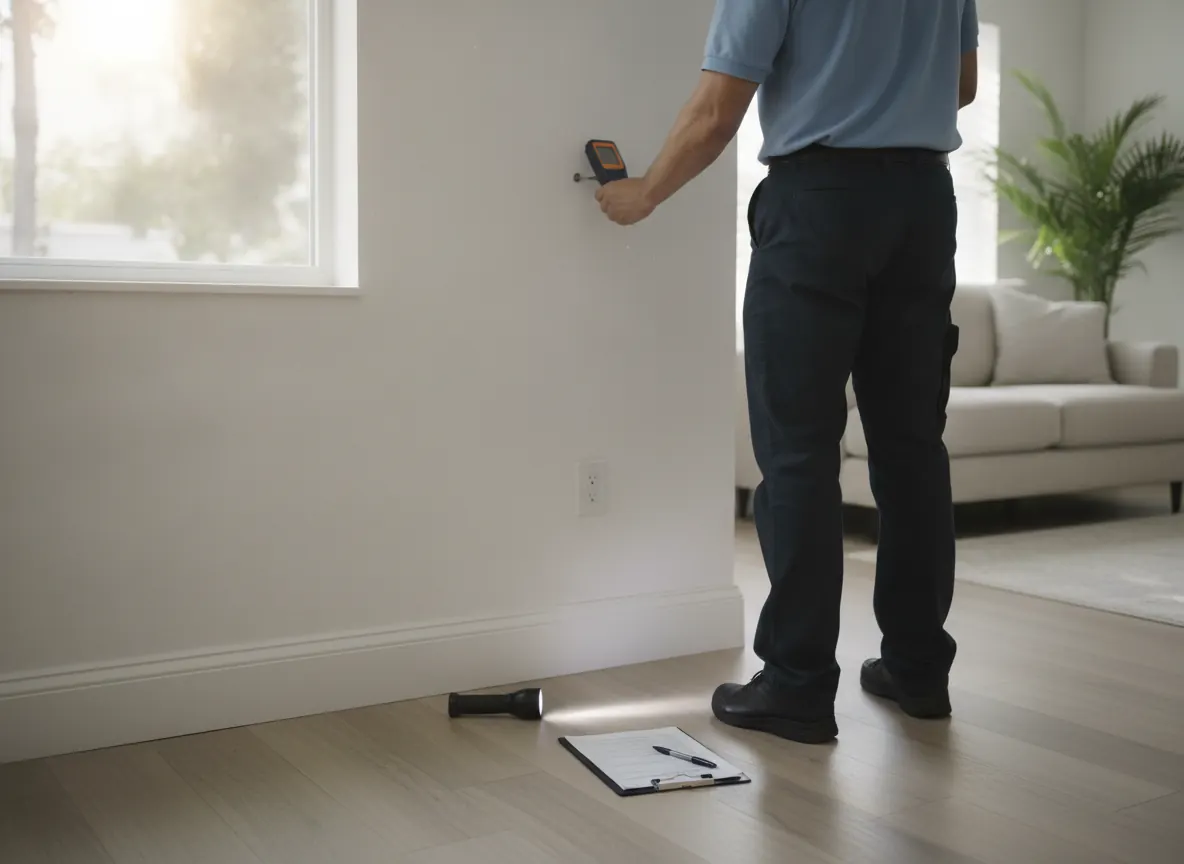
Using a moisture meter and other tools to find wet materials that look dry on the surface.
Sampling, when it helps
Air or surface samples sent to a lab, often with an outdoor comparison sample. Sampling is most useful when mold is suspected but not visible, such as a musty smell with no obvious source.
A written report
Findings, the suspected moisture source, the affected areas, and often a scope of work that a remediator can quote against.
That written scope is often the most valuable part. It lets you get comparable quotes from remediators, and after the work, a follow-up check can show whether the job met the scope. Under Florida's 12-month rule (s. 468.8419), the assessor and remediator are typically separate companies, except for Division I certified contractors as the statute describes. Our article on the 12-month rule explains why. Ask any company for its Florida license number and verify it at MyFloridaLicense.com.
When a professional assessment makes sense
- You smell mold but can't see it.
- Visible growth looks larger than about 10 square feet, or keeps coming back after cleaning.
- Your home took on water from a storm, flood or plumbing leak. See mold after a hurricane or flood.
- You're buying or selling a home, or need documentation for an insurer or condo association.
- You want clear documentation after remediation is finished.
What a mold inspection typically costs
Typical national ranges from cost guides, 2025–2026 — not quotes: a mold inspection runs about $450–$800, with a national average around $500 and a Florida average of about $739. Extra samples are often $60–$80 each. Compare that with the cost of remediation, which cost guides put at about $1,200–$3,750 for a typical job, and you can see why getting the scope right matters. This Old House notes that remediation quotes may not include inspection or clearance testing. Learn more on our mold inspection and testing page and in our guide to mold inspection cost in Florida.
Get quotes from licensed assessors
Fort Myers Mold Pros is a free quote and referral service. We connect Fort Myers and Lee County homeowners with Florida-licensed mold assessors and remediators. Tell us what you're seeing or smelling, and we'll help you get quotes from licensed local pros. Request a free quote; we usually reply the same day.
Frequently asked questions
Are home mold test kits worth buying?
Usually not as a first step. Mold spores are normally present in indoor and outdoor air, so a kit will often grow something without telling you where moisture is or how big the problem is. EPA says that in most cases, if visible mold growth is present, sampling is unnecessary. Fixing the moisture source and cleaning up matter more.
When is professional mold testing worth it?
Sampling is most useful when mold is suspected but not visible, such as a musty smell with no obvious source, or after water damage where growth may be hidden in walls. A Florida-licensed mold assessor can combine a visual inspection, moisture readings and lab samples with a written report that remediators can quote against.
How much is a mold inspection in Florida?
Cost guides list a typical national range of about $450–$800, with a national average around $500 and a Florida average of about $739. Extra samples often cost $60–$80 each. These are typical ranges, not quotes; the real price depends on the home and the scope a licensed assessor recommends.