
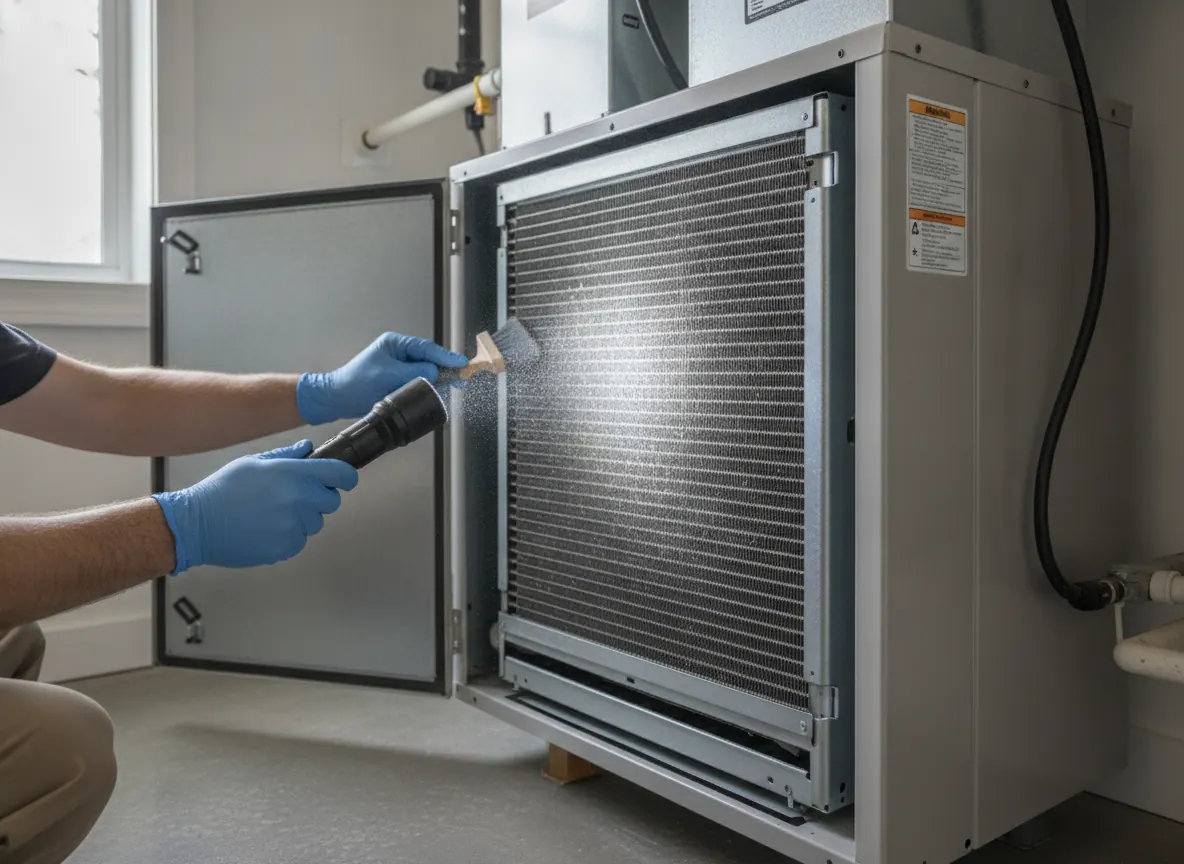
Mold in AC vents is one of the most common moisture complaints in Southwest Florida. The short answer to "why do I have mold in my AC vents?" is that air conditioning is a moisture machine. It pulls water out of humid air, and in a climate like Lee County's, it does that almost all year. When some of that moisture ends up where it should not, on cold metal, in duct insulation, or in a drain pan that does not drain, mold can follow.
Southwest Florida's climate keeps your AC wet
The numbers explain a lot. Florida State University's Florida Climate Center reports average relative humidity in Fort Myers of about 88% in the morning and 55% in the afternoon, and morning humidity stays between 84% and 91% in every month of the year. NOAA's 1991–2020 climate normals for Fort Myers Page Field show 57.41 inches of rain a year, with about 78% of it falling from May through October, and an average of about 120 days a year at or above 90°F.
So your system runs long hours, in hot weather, while pulling moisture from very damp air. That is exactly what it is designed to do, but it means any weak spot in how water is collected and drained gets tested constantly.
How condensation turns into mold
An air conditioner cools air by passing it over a cold evaporator coil inside the air handler. Water condenses on that coil the way it does on a cold glass, drips into a drain pan, and leaves through a condensate line. Mold problems usually start when that water, or condensation elsewhere in the system, has nowhere to go:
- Clogged condensate drain or overflowing pan. If the line backs up, water sits in the pan or spills into the air handler closet.
- Sweating supply registers and ducts. When very cold air meets warm, humid air at a vent or around poorly insulated duct, condensation forms on the surface. Dust plus moisture gives mold a place to grow.
- Air leaks into the system. Gaps in the air handler cabinet, return or ductwork can pull in humid air from an attic, garage or wall cavity.
- Oversized or short-cycling systems. A system that cools quickly and shuts off may not run long enough to remove much moisture, leaving indoor humidity high.
- Thermostat set very low or the system off for long stretches. Very cold supply air can make registers sweat, while a home that is closed up with the AC off, common in seasonal homes, can get humid indoors.
- Dirty filters and coils. Dust collects moisture and can feed growth on coils and in the blower area.
Often the mold on a vent cover is a symptom. The real question is where the moisture is coming from. As EPA's mold guide puts it, "If you clean up the mold, but don't fix the water problem, then, most likely, the mold problem will come back."
What you can check yourself
Some quick checks can help you describe the problem when you call for help:
Look at the filter
Is it overdue for a change? Is it wet or discolored?
Check the drain pan and line
Standing water in the pan, water on the closet floor, or a float switch that keeps shutting the system off all point to a drainage problem.
Note where the growth is
Is it only on one or two registers, on many vents, or around the air handler itself? Is the vent cover sweating or dripping?
Note the smell
Does a musty odor come mainly when the system starts?
Check indoor humidity
An inexpensive hygrometer can tell you whether indoor humidity stays high even with the AC running.
EPA's guide says homeowners can usually clean up a moldy area smaller than about 10 square feet themselves. Wiping a small spot off a removable vent cover is very different from cleaning inside ductwork or an air handler, though, and you should not disturb growth inside the system without professional advice.
When to call an HVAC pro vs. a licensed mold pro
These are different trades, and many AC mold situations involve both.
Call an HVAC contractor when the problem is mechanical
Clogged condensate lines, overflowing pans, sweating ducts, poor duct insulation, leaky returns, dirty coils, short cycling and humidity control are HVAC issues. If a small amount of growth is limited to a register and the cause is a fixable drainage or condensation problem, an HVAC contractor may be the right first call.
Call a Florida-licensed mold pro when the growth is larger or hidden
If growth covers a larger area, spreads through ductwork, shows up on many vents, or appears around the air handler closet, walls or ceiling, it may go beyond a simple cleaning. Florida Statutes s. 468.8411 defines mold remediation as treatment of mold or mold-contaminated matter "of greater than 10 square feet," and that work is generally for a Florida-licensed mold remediator. A Florida-licensed mold assessor can evaluate where the growth is and how far it extends. Under Florida's 12-month rule (s. 468.8419), the assessor and remediator are typically separate companies, except for Division I certified contractors as the statute describes. This is general information, not legal advice.
Ask any company for its Florida license number and verify it at MyFloridaLicense.com. Our guide on verifying a Florida mold license shows how. And in either case, the moisture source has to be fixed, or the growth is likely to return.
Can mold in the AC make you sick?
We do not give medical advice. If you or someone in your home has symptoms you think could be related to mold, or has asthma, allergies or a weakened immune system, talk to a doctor. What we can say is that EPA's guidance focuses on controlling moisture and cleaning up mold, and that it is reasonable to deal with visible growth in the system rather than ignore it.
What HVAC mold work typically costs
Costs depend on the size of the system, how far growth has spread and what has to be replaced. Typical national ranges from cost guides, 2025–2026 — not quotes: HVAC system and duct mold remediation runs about $3,000–$10,000. A mold inspection typically runs $450–$800, with a national average around $500 and a Florida average of about $739; extra samples are often $60–$80 each. This Old House notes that remediation quotes may not include inspection or clearance testing. A licensed pro's on-site assessment sets the real price. See the full mold remediation cost guide and our AC and HVAC mold page.
Get quotes from licensed local pros
Fort Myers Mold Pros is a free quote and referral service. We connect Fort Myers and Lee County homeowners with Florida-licensed mold assessors and remediators. Tell us what you're seeing in your vents and we'll help you get quotes from licensed local pros. Request your free quote; we usually reply the same day.
Frequently asked questions
Is mold in AC vents common in Florida?
It is a frequent complaint in humid climates. In Fort Myers, morning relative humidity averages about 88% and stays between 84% and 91% every month, according to the Florida Climate Center. AC systems remove a lot of moisture from that air, so clogged drains, sweating registers and leaky ducts can quickly create damp spots where mold grows.
Can I just wipe the mold off my vent covers?
EPA says homeowners can usually clean a moldy area smaller than about 10 square feet. A small spot on a removable register is often in that range, but growth that returns quickly, appears on many vents, or sits inside ducts or the air handler points to a moisture problem that a professional should look at.
Should I call an HVAC company or a mold company?
Often both. An HVAC contractor fixes the moisture cause, such as a clogged condensate line, sweating ducts or poor humidity control. If growth is larger than about 10 square feet or spread through the system, Florida law generally calls for a licensed mold remediator, and a licensed assessor can evaluate the extent. This is general information, not legal advice.